Two Poems
On missing a mother and the nature of grief

Grief Comes On a Friday at 4 p.m.
A craving for your spinach and mushroom crepes.
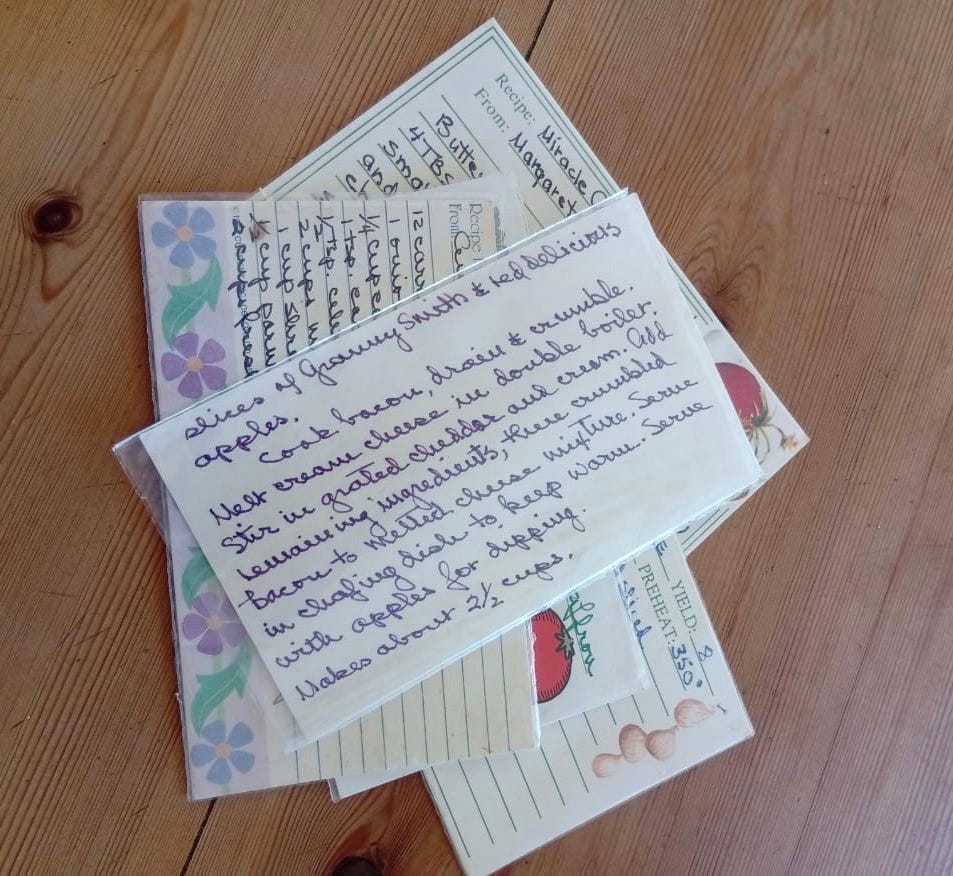
The plastic recipe box. Colored tabs for appetizers,
main dishes, desserts. Your left-handed back slant,
smudged ink, a greasy fingerprint—
all landing like a gasping hammer. Where have you been?
I don’t think I ever buried you. You bloomed in me
right there at the kitchen counter on a Friday at 4 p.m.
The missing wail so deep and gaping, a childhood slipped
from those protective sleeves. A kind of birth, a difference.
A truth about keeping—you never did, and I never will,
make all the good things.
(Originally published in One Art: a journal of poetry, on May 2, 2025)

Triolet for Grief
How can I convince you, grief?
By telling you I no longer care?
You’d turn my spring scars to bloodleaf.
Then how can I convince you, grief?
When you blow on the wound and call it relief.
When you rack up the years but lock the highchair.
So how can I convince you, grief?
I’m telling you. I no longer care.

Today is the anniversary of my mother’s death. She had the good sense to leave this world in 2019 before Covid hit and changed everything. She was 90 years old and at the end stages of Parkinson’s. She would have hated the isolation of Covid. As it is, she went peacefully on All Saint’s Day in her own home, with my brother holding her hand. Raised a Catholic, when asked the day before if she wanted a priest to come and read her last rites, she said, “well, I don’t think he’s going to tell me anything I don’t already know.” And that was that. Humor still intact.
She was a fantastic cook, and so many of my memories of her are centered around food and the passionate way she went about bringing it to life on the table. Certain smells can take me back to childhood in an instant. I inherited her measuring cups and spoons and her love of cooking. She resides still whenever I open the oven door, in the form of paper-thin, garlic-scented potatoes bathed in cream, and in any recipe I try to recreate. And most recently, through the vestiges of flour and butter on a recipe card.
If I have learned anything about grief since her passing, it’s how unlinear it is, how unformulaic, how unexpected it can be. It can sneak up on you, take you over, and knock you down when you least expect it. Where joy likes to be celebrated in its singularity, grief likes to call its friends to its side—past losses, painful memories, regrets—so that the weight of it can feel almost unbearable. We try to cheat grief, dodge it with distraction, wave it away, convince it we, “no longer care.”
But grief is not having any of it. It visits with all the arrogance and tenacity of a thunder clap or a rip tide. Sometimes more gently as a fingerprint, just when we begin to forget. Mercifully, it tends to leave when we have remembered well.
Blessings and blue skies,

P.S. If you’d like to learn more about the French Triolet, the form I used in my second poem, you can do so here, then give it a try yourself. It’s a melodic form that relies on rhyme and repetition.
What love you make of grief! Beautiful!
Oh Ellen... I can't write for crying.